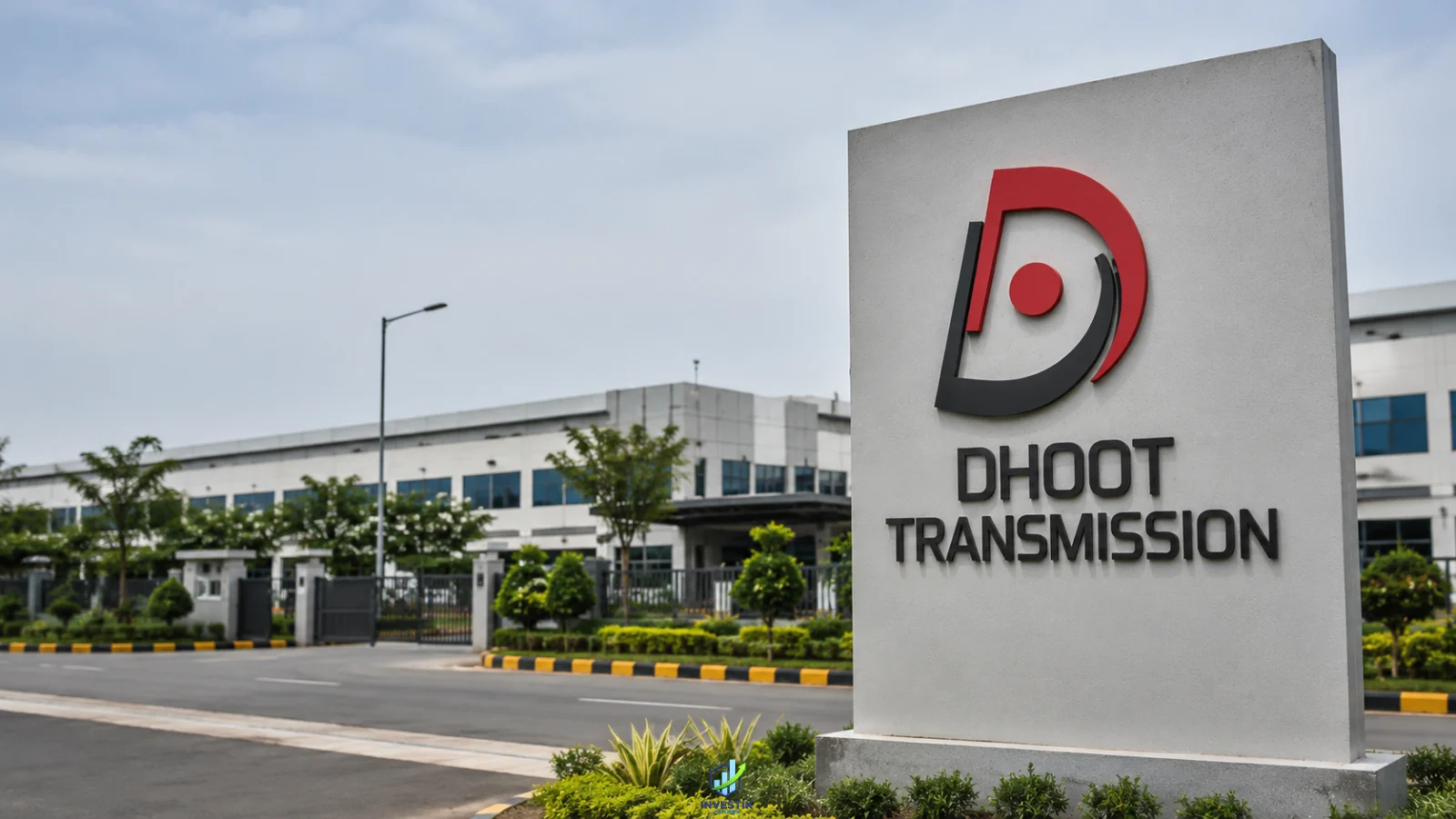

Dhoot Transmission shares made a strong debut on the Indian stock market on Monday, August 17, 2026, opening well above its IPO price and delivering a strong listing gain. The stock listed at ₹1,200 on the BSE and ₹1,193.80 on the NSE, a premium of roughly 38% over the IPO issue price of ₹871. The strong debut follows heavy demand for the company’s IPO and has put the auto-component maker in focus. So what drove investor interest, and what should investors know about the company behind the listing?
This article explains Dhoot Transmission’s strong 38% stock-market debut, what drove investor interest, what the company does, and the key growth factors and risks investors should watch.
Dhoot Transmission Share Price Today
Dhoot Transmission shares listed on both exchanges on August 17, 2026, comfortably beating the top end of their price band.
| Particular | Details |
| IPO price band | ₹829–₹871 per share |
| Final IPO price | ₹871 per share |
| NSE listing price | ₹1,200 (up 37.77%) |
| BSE listing price | ₹1,193.80 (up 37.06%) |
| Issue size | ₹3,066.89 crore |
| Listing date | August 17, 2026 |
One lot of 17 shares cost ₹14,807 at the upper end of the price band. Based on the NSE listing price, investors who received an allotment saw the value of one lot rise to around ₹20,400, a gain of close to ₹5,600 per lot on listing day alone.
These are opening prices recorded at listing on August 17, 2026. Investors tracking the stock later in the day or in subsequent sessions should check live exchange data, since intraday and closing prices can move away from the listing price.
Why Did Dhoot Transmission Shares List Strongly?
There isn’t a single reason behind the strong debut. A mix of heavy IPO demand, positive grey-market signals, well-known private equity backing, and the company’s position in a growing segment of the auto-components industry all appear to have played a part.
1. Strong IPO subscription
The IPO was subscribed 74.21 times overall on the final day of bidding. The offer received bids for over 185 crore shares against roughly 2.5 crore shares on offer. Demand was led by institutional investors: the qualified institutional buyers (QIB) portion alone was subscribed 212.92 times.
The retail portion was subscribed 8.12 times, while the NII segment was subscribed 51.93 times. Ahead of the IPO, the company had already raised ₹918.3 crore from anchor investors, including SBI Mutual Fund, HDFC Mutual Fund, BlackRock, the Abu Dhabi Investment Authority, ICICI Prudential Mutual Fund and others, a signal that large institutions were positioning early.
2. Positive grey-market indication
In the days before listing, Dhoot Transmission’s shares were trading at a premium in the unofficial grey market. It’s worth being clear that grey-market premium (GMP) is an unofficial, unregulated indicator based on informal trading and is not a guaranteed forecast of the listing price. In this case, the eventual listing gain was broadly in line with what the grey market had been suggesting, but GMP shouldn’t be treated as a reliable predictor on its own; it’s simply one signal among several that reflected pre-listing sentiment.
3. Bain Capital’s backing
Dhoot Transmission counts Bain Capital as a major shareholder. The global private equity firm, through its entity BC Asia Investments XV, acquired a significant minority stake in the company in early 2025 and held around 55% of the pre-issue share capital. Bain Capital’s involvement also brought institutional backing to the company ahead of its public listing. However, its backing does not guarantee future stock performance.
4. A leading position in wiring harnesses
Dhoot Transmission is one of the largest suppliers of wiring harnesses to India’s two-wheeler and three-wheeler industry, holding a combined market share of around 41%, according to figures disclosed in the company’s IPO prospectus. It counts Bajaj Auto, TVS Motor, Honda Motorcycle & Scooter India and Royal Enfield among its long-standing customers, relationships that, on average, go back about 13 years with its top five clients.
Bajaj Auto alone accounted for close to 32% of FY2026 revenue. This kind of entrenched, high-share position in a niche but essential auto-component category is often attractive to investors evaluating component suppliers.
5. The EV opportunity
Dhoot Transmission’s exposure to electric vehicles appears to be a meaningful part of the investment case. The company holds close to 70% market share in the electric two-wheeler and three-wheeler wiring harness segment, per its IPO prospectus, and its EV-related revenue share rose from about 16% in FY2024 to roughly 24% in FY2026.
Nearly all of its automotive product portfolio is described as EV-focused or powertrain-neutral, meaning it isn’t tied to one type of vehicle technology. The company’s expansion into EV-related components gives investors exposure to the broader shift toward vehicle electrification, though how that plays out over time will depend on the pace of EV adoption in India.
What Does Dhoot Transmission Do?
Dhoot Transmission is an automotive-component manufacturer that designs and supplies electrical and electronic products used in vehicles. Its core product is the wiring harness, the network of cables, connectors, switches, sensors, and junction boxes that carries power and data through a vehicle.
The company primarily serves the two-wheeler and three-wheeler segment, along with some commercial-vehicle and farm-equipment applications, and has expanded into EV-specific components such as battery packs and other electrical systems for electric two- and three-wheelers. It runs 22 manufacturing facilities across India, the UK, Slovakia and Thailand, along with engineering centres and warehouses, and employs more than 10,000 people. Bajaj Auto is its largest customer, and its top five customers together made up over 71% of FY2026 revenue.
Dhoot Transmission IPO: Key Details
The ₹3,066.89 crore IPO was a mix of a fresh issue worth ₹1,400 crore and an offer for sale worth roughly ₹1,666.89 crore by existing shareholders, Bain Capital entity BC Asia Investments XV and Mangalam Capital.
The issue was open for subscription from August 10 to August 12, 2026, in a price band of ₹829–₹871 per share, and was subscribed 74.21 times overall. Proceeds from the fresh issue are earmarked for repaying company and subsidiary borrowings, setting up new wiring-harness manufacturing units in Jhajjar (Haryana) and Hosur (Tamil Nadu), and funding acquisitions and general corporate purposes.
Dhoot Transmission Financial Performance
For FY2026 (year ended March 2026), Dhoot Transmission reported total income of around ₹4,563.70 crore, up about 31% from ₹3,472.24 crore in FY2025. Profit after tax rose to ₹396.84 crore in FY2026, from ₹353.89 crore the year before. EBITDA for FY2026 stood at around ₹711 crore.
Alongside the strong top-line growth, some profitability ratios softened. The EBITDA margin eased from about 17.15% in FY2025 to 15.71% in FY2026, and the PAT margin fell from roughly 10.19% to 8.70% over the same period. On a more positive note, the company’s debt-to-equity ratio improved sharply, from 0.78 in FY2025 to 0.35 in FY2026, partly reflecting the capital infusion from Bain Capital’s investment.
What Could Support Dhoot Transmission’s Growth?
A few factors could support the company’s growth going forward, though none of them are guarantees:
- Continued growth in two-wheeler and three-wheeler production in India, the world’s largest two-wheeler market
- Rising “kit value” per vehicle as electrification adds more circuits, sensors and wiring content to each vehicle
- Its already-strong position in the EV wiring harness segment, which could benefit further as EV adoption increases
- Planned new manufacturing capacity in Haryana and Tamil Nadu
- The planned use of IPO proceeds to repay borrowings, which could help reduce the company’s debt burden and free up resources for expansion or acquisitions
- Potential for deeper relationships with existing OEM customers and expansion into new geographies
What Are the Risks?
Investors weighing Dhoot Transmission should also keep several risks in mind:
- Automotive-sector dependence: About 65% of FY2026 revenue came from two-wheelers and another 13% from three-wheelers, so any slowdown in these vehicle categories would directly affect the business.
- Customer concentration: Bajaj Auto alone made up close to 32% of FY2026 revenue, and the top five customers accounted for over 71%. Losing or reducing business with a major customer could have an outsized impact.
- Margin pressure: EBITDA and PAT margins both declined in FY2026 even as revenue grew, which is worth watching in future results.
- EV transition risk: While the company is positioned as “powertrain-neutral,” the pace and shape of India’s EV transition remains uncertain and could affect demand patterns.
- Valuation after a strong listing: Valuation is another factor investors should consider after the strong listing. A sharp debut does not guarantee future returns, so investors should assess the company’s earnings, growth prospects, and valuation rather than relying only on the listing gain.
- General market volatility: Like any newly listed stock, Dhoot Transmission’s share price could see sharp swings in its early trading sessions.
Dhoot Transmission: What Investors Should Watch Next
Going forward, a few things are worth tracking:
- Quarterly revenue and profit growth, and whether margin pressure eases or continues
- Growth in the EV-related share of revenue
- Progress on new manufacturing capacity in Haryana and Tamil Nadu
- Any new OEM customer wins or order additions
- Debt levels and cash flow, especially after the debt-repayment use of IPO proceeds
- Commentary from management on export growth and international operations
- How the stock’s valuation evolves relative to listed peers in the auto-components space
Should Investors Buy Dhoot Transmission After the Listing?
The listing gain shows strong initial investor interest, but a strong debut alone does not determine whether the stock is attractively valued at current levels. Investors should look at earnings growth, the EV opportunity, margin trends, customer concentration, and overall valuation, rather than the listing-day pop alone, before making any investment decision.
Final Verdict
Dhoot Transmission’s strong stock-market debut reflects the heavy demand seen during its IPO and investor interest in its position in the automotive components market. Its strong presence in wiring harnesses, growing exposure to EV-related components and plans to expand manufacturing capacity could support the business going forward. At the same time, the company faces risks from customer concentration, dependence on the two- and three-wheeler market and pressure on profitability margins.
The stock’s nearly 38% listing gain also means investors should look beyond the initial excitement and assess its valuation, earnings growth, and future business performance. A strong debut is a positive start, but it does not by itself determine the stock’s long-term potential.




FAQs
What is the Dhoot Transmission IPO price?
The IPO price band was ₹829–₹871 per share, with the final issue price set at ₹871.
At what price did Dhoot Transmission shares list?
The stock listed at ₹1,200 on the NSE and ₹1,193.80 on the BSE on August 17, 2026.
How much did Dhoot Transmission shares gain on listing?
Shares gained about 37.77% on the NSE and 37.06% on the BSE over the IPO issue price.
What does Dhoot Transmission do?
It designs and manufactures wiring harnesses and related electrical/electronic components for two-wheelers, three-wheelers, commercial vehicles, and farm equipment, including EV-specific products.
How much was the Dhoot Transmission IPO subscribed?
The IPO was subscribed 74.21 times overall, with the QIB portion subscribed 212.92 times.
ARN Disclosure: Investik Future is an AMFI-registered Mutual Fund Distributor. ARN-341107 — Verify on AMFI ↗. Komal Thakur is the content author and digital marketer; the ARN registration belongs to Investik Future, not to the author personally.