
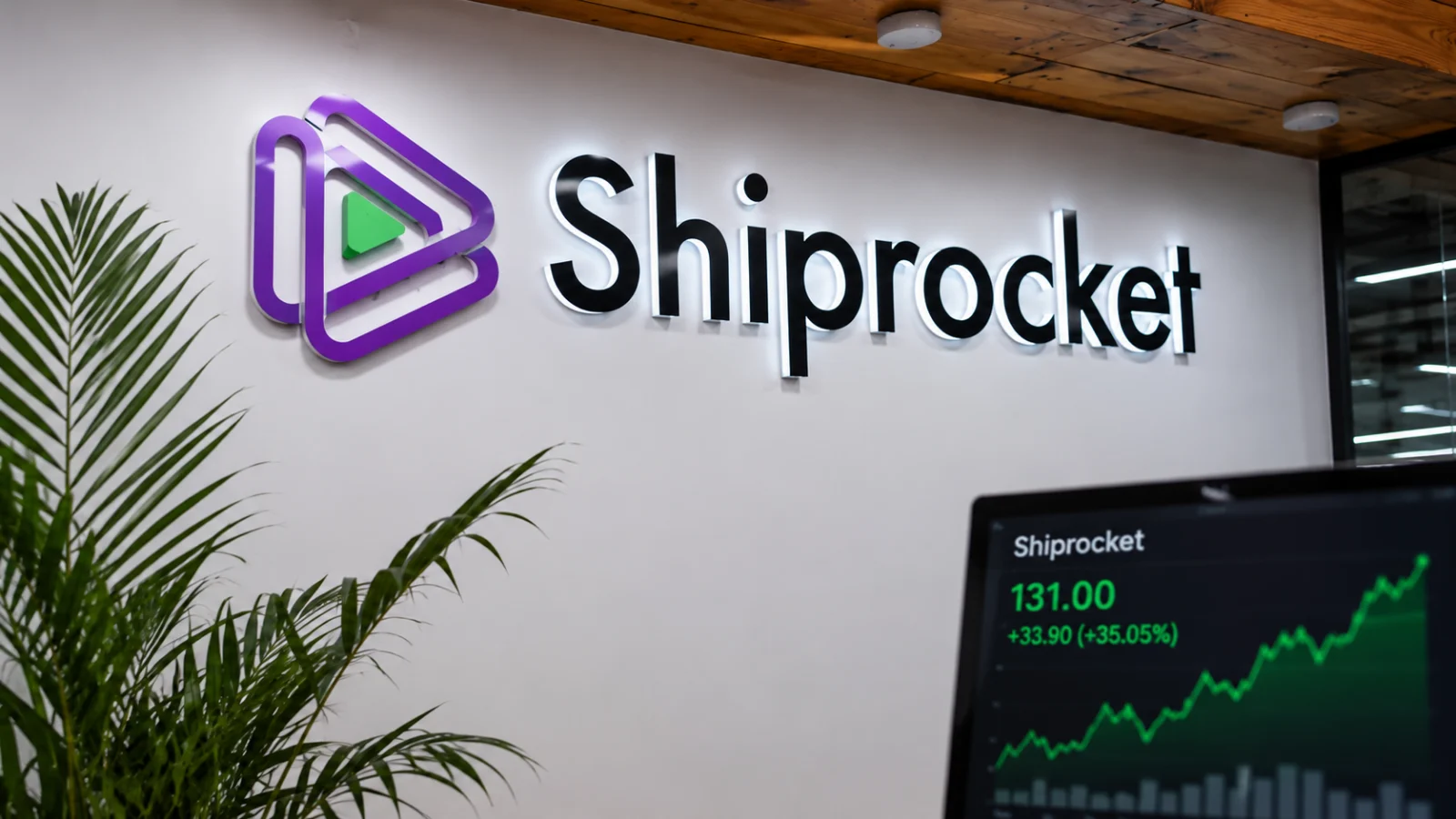

Shiprocket made its stock market debut on August 19, 2026, with Shiprocket shares listing well above their IPO issue price. The stock opened at ₹131 on the NSE, a 35.05% premium over the ₹97 issue price, while it listed at ₹129.50 on the BSE, up 33.51%.
The strong debut came after the IPO was subscribed 99.38 times, highlighting the strong demand for the issue. But what drove the sharp listing gain, and can Shiprocket’s business fundamentals support the market’s expectations?
This article looks at Shiprocket’s share price after its market debut, the reasons behind the strong listing, IPO demand, the company’s financial performance, key risks, and what investors should watch going forward.
Shiprocket Share Price Today
Here’s how the listing played out on both exchanges.
| Particular | Details |
| NSE listing price | ₹131 |
| BSE listing price | ₹129.50 |
| IPO issue price | ₹97 |
| NSE listing gain | 35.05% |
| BSE listing gain | 33.51% |
| Listing date | August 19, 2026 |
Shiprocket’s market capitalisation moved to roughly ₹9,400–9,500 crore after listing, up from about ₹7,058 crore at the issue price. These are opening-trade figures. If you’re checking the share price later in the day or on a different date, the number will have moved from the listing price above; treat ₹131 as the debut price, not necessarily the current one.
Why Did Shiprocket Shares Jump on Listing?
Strong IPO subscription
The IPO was subscribed 99.38 times by the close of bidding, with the qualified institutional buyers (QIB) portion alone drawing roughly 123 times demand. That kind of response usually points to a few things: healthy investor appetite for the company’s growth story, and broader positive sentiment toward India’s e-commerce and logistics-technology space. It’s worth being careful here; strong subscription reflects demand at the time of bidding, not a verdict on whether the stock is undervalued or fairly priced.
An e-commerce enablement business with a large merchant base
Shiprocket is an e-commerce enablement platform, not a plain courier company. It provides shipping, fulfilment, checkout, payments, cross-border logistics, and now AI-linked tools for the online sellers who use it, from small D2C brands to larger retailers. That range of services, spanning the full post-purchase journey, is part of why investors are treating this as a bet on India’s broader digital-commerce infrastructure rather than a single-service logistics play.
Investors are pricing in growth, not guaranteeing it.
The company’s exposure to India’s expanding e-commerce ecosystem may support its long-term growth opportunity. That’s different from saying growth is assured. A listing-day pop reflects what investors are willing to pay today based on expectations; whether Shiprocket delivers on those expectations will show up in its results over the next several quarters, not on day one.
Shiprocket IPO: Issue Price and Listing Details
The IPO ran from August 12 to August 14, 2026, with a price band of ₹92–₹97 per share and a lot size of 154 shares. The final issue price was set at the top of the band, ₹97.
The total issue size came to about ₹1,617 crore, split between a fresh issue of roughly ₹885.5 crore and an offer for sale of about ₹732 crore by existing shareholders. That’s smaller than the ₹2,000–2,500 crore raise the company had originally been reported to be planning when it filed confidentially with SEBI. Proceeds from the fresh issue are earmarked for technology and AI investment, debt repayment, potential acquisitions, and general corporate purposes.
How Strong Was Shiprocket IPO Subscription?
The overall issue was subscribed around 99.38 times, led by strong institutional demand.
| Investor Category | Subscription |
| QIB | ~123x |
| Overall | ~99.4x |
The strong QIB demand indicates substantial institutional interest in the IPO, although subscription data alone does not establish whether investors consider the stock fairly valued.
Shiprocket Financial Performance
A strong listing on its own doesn’t tell you much about the underlying business, so it’s worth looking at the numbers behind it.
Shiprocket’s operating revenue grew about 24% year-on-year to roughly ₹2,024 crore in FY26. Over FY24–FY26, the company posted a revenue CAGR of around 24%. On profitability, reports diverge slightly depending on which loss measure is used: the company’s adjusted loss narrowed sharply, from about ₹351 crore in FY24 to roughly ₹76 crore in FY26, while its statutory net loss for FY26 has been reported at close to ₹79 crore, up from the prior year.
Cash flow from operations turned positive at around ₹52.6 crore for the year ended March 31, 2026. Net worth rose to about ₹1,524 crore as of March 2026, from ₹1,491 crore a year earlier, and net debt stayed broadly flat at around ₹242 crore.
Has Shiprocket Turned Profitable?
Not yet, on a statutory basis. The adjusted loss has come down meaningfully over the past two financial years, and operating cash flow has turned positive, which are both reasonable signs of improving unit economics. But the reported net loss for FY26 was still around ₹79 crore, wider than the year before on that specific measure. Investors should watch whether the gap between “adjusted” and “reported” profitability narrows in coming quarters, since that gap often reflects one-off items, ESOP costs, or other adjustments that don’t always shrink in a straight line.
What Makes Shiprocket’s Business Interesting?
Shiprocket has built a large merchant network around its e-commerce enablement platform. The company says more than 4 lakh businesses and sellers have used its platform, while its IPO disclosures have separately reported active-merchant figures. Its platform covers more than 19,000 pin codes in India and reaches more than 160 countries through cross-border shipping.
The company has previously said that up to 60% of its business comes from non-metro markets, pointing to demand from smaller sellers outside India’s largest cities. It has also built out Shiprocket Omuni for omnichannel commerce and is directing a meaningful share of its fresh IPO proceeds into AI, with the stated goal of evolving from a shipping tool into a broader operating system for online merchants.
What Are the Risks for Shiprocket Investors?
Competition. The e-commerce enablement and logistics-tech space in India includes multiple well-funded players, and competitive intensity could pressure margins.
Profitability. The company is still loss-making on a reported basis. Investors need to track whether losses keep narrowing and whether that trend holds up as the company scales.
Valuation. A 35% listing pop pushes the stock to a valuation that may already price in a good deal of future growth. Following the listing, the stock’s valuation moved higher from its IPO pricing, increasing the premium investors are paying for future growth, which raises the bar for what the company needs to deliver.
E-commerce dependence. Shiprocket’s fortunes are tied closely to the health of India’s online retail and D2C ecosystem. A slowdown in e-commerce activity or merchant growth would flow through to its numbers.
Execution risk. Scaling a services platform while managing costs, especially with fresh capital going into AI investment, carries its own delivery risk.
Market volatility. Newly listed stocks, especially those that debut at a large premium, can see sharp price swings in the weeks after listing as early allottees book profits.
Is the 35% Listing Gain Sustainable?
A strong listing does not necessarily mean the gain will be sustained. IPO demand and listing-day sentiment reflect what investors were willing to pay based on expectations set during bidding, but they don’t automatically translate into sustained earnings growth or justify the stock’s valuation. They don’t automatically translate into sustained earnings growth, and they say nothing about valuation discipline once the initial excitement settles. A listing gain is a starting point for the market’s view on Shiprocket, not a guarantee of where the stock goes next.
What Should Investors Watch Next?
- Revenue growth and merchant/customer additions
- Shipment volumes and gross merchandise value trends
- Operating margins and progress on loss reduction
- Operating cash flow consistency
- Path toward sustained statutory profitability, not just adjusted-loss narrowing
- Traction on AI-linked products and whether they add measurable revenue
- Competitive dynamics in e-commerce enablement and logistics-tech
- Quarterly results once the company starts reporting as a listed entity
- How the stock’s valuation multiples move relative to listed peers
Should Investors Buy Shiprocket Shares After the Listing?
A 35% listing gain alone does not establish whether the stock is attractively valued. Investors should weigh the company’s earnings trajectory, business growth, current valuation, competitive position, and their own risk tolerance before making an investment decision. This is not a recommendation to buy, sell, or hold the stock.
Final Verdict
Shiprocket’s debut was a strong IPO listing, backed by close to 99 times overall subscription and a 35% premium on the NSE. The business itself, an e-commerce enablement platform with a large merchant base and multiple revenue streams, has shown real progress: revenue growing at a 24% CAGR, losses narrowing on an adjusted basis, and operating cash flow turning positive.
At the same time, the company remains loss-making on a reported basis, and the strong listing has raised the valuation at which investors are now buying the stock, increasing the importance of future earnings and growth. The strong debut shows the market’s appetite for Shiprocket’s story. Whether that translates into a sound long-term investment will depend on how consistently the company can convert its growth into sustainable, reported profitability.





FAQs
What is the Shiprocket share price today?
Shiprocket listed on August 19, 2026, at ₹131 on the NSE and ₹129.50 on the BSE. Check a live market feed for the current trading price, since it will move through the day.
At what price did Shiprocket shares list?
Shiprocket shares listed at ₹131 on the NSE and ₹129.50 on the BSE, against an IPO issue price of ₹97.
Why did Shiprocket shares jump on listing?
Strong IPO subscription of close to 99 times, led by institutional investors, along with investor interest in Shiprocket's e-commerce enablement business, drove the 35% listing premium.
What was the Shiprocket IPO issue price?
The final issue price was ₹97 per share, at the top end of the ₹92–₹97 price band.
How much was the Shiprocket IPO subscribed?
The IPO was subscribed around 99.4 times overall, with the QIB portion drawing roughly 123 times demand.
ARN Disclosure: Investik Future is an AMFI-registered Mutual Fund Distributor. ARN-341107 — Verify on AMFI ↗. Komal Thakur is the content author and digital marketer; the ARN registration belongs to Investik Future, not to the author personally.