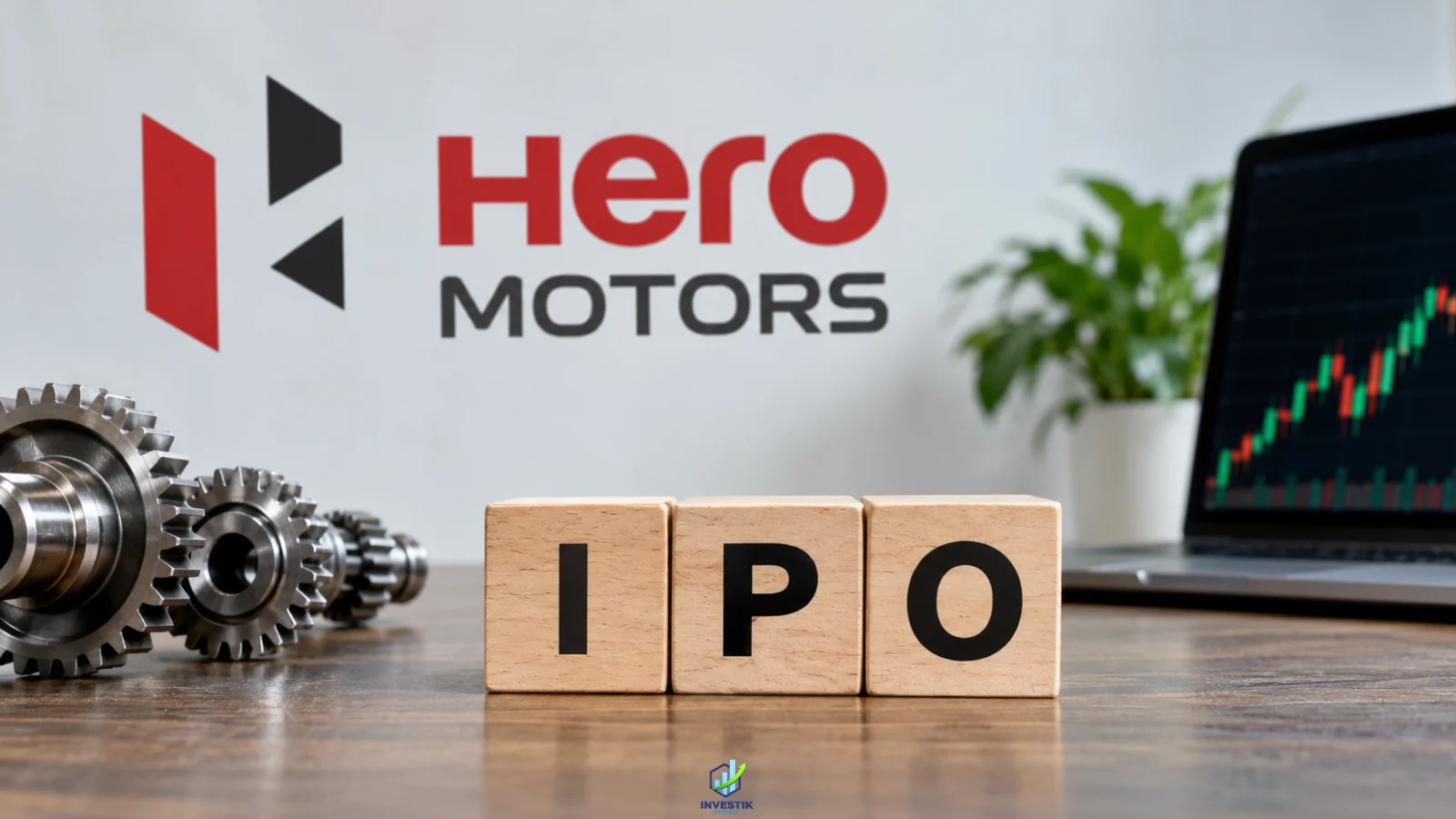

The Hero Motors IPO opens for subscription on September 16, 2026, and closes on September 18, 2026. It is a ₹1,000 crore mainboard IPO, with a price band of ₹79 to ₹84 per share. The issue has already drawn attention because of the Hero name, its size, and its exposure to the electric vehicle (EV) components business.
This article breaks down everything a first-time IPO investor needs to know about the Hero Motors IPO, what the company does, the IPO structure, its financial numbers, valuation, current grey market premium (GMP), and the risks worth understanding before making an investment decision.
What Is Hero Motors?
Hero Motors is an automotive components and powertrain engineering company. In simple terms, it designs and manufactures the mechanical and electrical parts that make a two-wheeler, e-bike, or small vehicle actually move.
Its main areas of work are:
- Powertrain solutions: this includes gears, transmissions, continuously variable transmissions (CVTs), electric motors, and integrated drive units. A “powertrain” is simply the set of components- engine or motor, gears, and transmission- that generate power and send it to the wheels. Whether a vehicle runs on petrol or electricity, it needs a powertrain to move.
- Alloys and metallics (A&M): this segment makes sheet-metal, tubular and machined components that are supplied to automotive manufacturers (called OEMs, or original equipment manufacturers).
Hero Motors serves both EV and non-EV customers. Its EV-related business, motors, EV transmissions and EV-focused gear sets, has been growing faster than the rest of the company in recent years. On the non-EV side, it continues to supply components for conventional two-wheelers and other vehicles.
The company has an international presence too. It runs six manufacturing facilities spread across India, the United Kingdom and Thailand, along with technology and design centres in India and the UK. Its client list includes global names such as BMW, Ducati and Enviolo, and a large share of its revenue, over 41% in FY26, comes from outside India.
Hero Motors vs Hero MotoCorp: What’s the Difference?
Because both companies carry the “Hero” name, it’s easy to assume they are the same business. They are not.
- Hero Motors is a separate, standalone automotive components and powertrain technology company. It is the one coming out with this IPO. It does not manufacture complete motorcycles or scooters for retail sale.
- Hero MotoCorp is India’s well-known two-wheeler manufacturer, which makes and sells motorcycles and scooters under its own brand. It is a separate listed company and is not part of this IPO.
Both companies do trace back to the larger Hero Group and share a common business lineage through the Munjal family, but they operate as independent entities with different businesses, different management, and different shareholders. When you read about the Hero Motors IPO, you are reading about the components and powertrain business, not about Hero MotoCorp’s motorcycle business.
Hero Motors IPO Details
| Particular | Detail |
| IPO opening date | September 16, 2026 |
| IPO closing date | September 18, 2026 |
| Anchor investor bidding | September 15, 2026 |
| Price band | ₹79 to ₹84 per share |
| Face value | ₹10 per share |
| Issue size | ₹1,000 crore |
| Fresh issue | ₹600 crore |
| Offer for sale (OFS) | ₹400 crore |
| Lot size | 178 shares |
| Minimum investment (retail, at upper band) | ₹14,952 |
| Listing exchanges | BSE and NSE |
| Basis of allotment (expected) | September 21, 2026 |
| Expected listing date | September 23, 2026 (tentative) |
Dates are as scheduled at the time of writing and can change. Always check the exchange or registrar website for the latest confirmed dates.
A quick word on two terms in that table:
- Fresh issue means the company itself issues new shares and receives the money raised. This money goes into the company’s own accounts and can be used for business needs like paying off debt or expanding capacity.
- Offer for sale (OFS) means existing shareholders, in this case, promoter entities, sell some of their existing shares to the public. The money from an OFS goes to those selling shareholders, not to the company.
Why Is the Hero Motors IPO Trending?
A few factors are driving interest in this IPO right now:
- Timing and size: A ₹1,000 crore mainboard IPO opening on September 16 is large enough to draw attention from institutional and retail investors alike, especially at a time when the Indian IPO market has been fairly active.
- Anchor book response: Hero Motors raised close to ₹300 crore from anchor investors, large institutional investors who commit money a day before the public issue opens, which is often seen as an early signal of institutional interest.
- The Hero name recognition: Even though Hero Motors is a separate business from Hero MotoCorp, the shared lineage draws attention from retail investors familiar with the broader Hero Group.
- EV and powertrain exposure: The company’s growing share of EV-related revenue has made it relevant to the broader conversation around India’s shift toward electric mobility.
- Grey market activity: Grey market activity has also added to interest in the IPO (more on this below).
None of these factors by themselves guarantee how the stock will perform after listing. They simply explain why the issue is getting more attention than a typical mid-sized IPO.
Hero Motors IPO: Fresh Issue and OFS
Of the total ₹1,000 crore issue:
- ₹600 crore is a fresh issue of new equity shares. This is new money that Hero Motors will use for its own business purposes, explained in the next section.
- ₹400 crore is an offer for sale, where promoter and promoter-group entities are selling a part of their existing shareholding to the public. Per the company’s Red Herring Prospectus (RHP), this comprises ₹395 crore by O P Munjal Holdings (the promoter selling shareholder) and ₹5 crore by Hero Cycles Limited (the promoter group selling shareholder).
In plain terms: fresh issue shares are brand new shares created by the company, and the money goes to the company. OFS shares are shares that already exist and are simply changing hands from the current owners to new investors, so the company itself does not receive that money.
How Will Hero Motors Use the IPO Money?
Based on the company’s offer documents, the net proceeds from the fresh issue are earmarked as follows:
- Around ₹190 crore for repayment or prepayment of some of the company’s existing borrowings, which should help reduce its interest costs.
- Around ₹200 crore for capital expenditure, mainly the purchase of equipment to expand capacity at its facility in Gautam Buddha Nagar, Uttar Pradesh.
- The remaining amount is for funding inorganic growth through unidentified future acquisitions, other strategic initiatives, and general corporate purposes.
Because the acquisition-related spending isn’t tied to a specific, named target yet, that portion of the proceeds carries more uncertainty than the debt repayment and capex portions, which are more clearly defined.
Hero Motors Financial Performance
| Particular (₹ crore) | FY24 | FY25 | FY26 |
| Revenue from operations | 1,064.39 | 1,089.59 | 1,188.35 |
| Total income | 1,083.42 | 1,111.23 | 1,216.74 |
| EBITDA | 86.28 | 114.00 | 147.78 |
| EBITDA margin | 8.11% | 10.46% | 12.44% |
| Profit after tax (PAT) | 17.04 | 32.80 | 41.17 |
| Net worth | 385.44 | 423.95 | 482.45 |
| Total borrowings | 304.00 | 407.62 | 400.79 |
Figures are as reported in the company’s offer documents (restated financials).
Here’s what these numbers show in plain language:
Revenue grew only modestly in FY24 and FY25, but picked up pace in FY26, rising about 9% year-on-year. Profitability improved at a faster rate than revenue; EBITDA margin expanded from roughly 8% to over 12% across the three years, and PAT more than doubled from FY24 to FY26. This means profitability improved faster than revenue during the period.
At the same time, borrowings rose from ₹304 crore in FY24 to around ₹400-408 crore in FY25 and FY26. This is one reason part of the fresh issue money is earmarked for debt repayment.
Hero Motors’ EV and Powertrain Business
Powertrain Solutions was the larger of Hero Motors’ two business segments in FY26, contributing about 53.67% of revenue, with Alloys & Metallics making up the remaining 46.33%.
Within the powertrain business, the EV-related portion has been growing quickly:
- EV-related revenue rose to about 23% of total revenue in FY26, up from roughly 12% in FY24.
- E-mobility revenue came in at around ₹273 crore in FY26, up about 55.6% year-on-year.
- The company’s Bike Powertrain business, which contributed close to ₹149 crore in FY26, is now focused entirely on EV applications.
The growth shows that EV-related products are becoming a larger part of Hero Motors’ business. However, some newer EV-focused facilities are still operating below full capacity. Investors should treat the EV growth story as a work in progress rather than something already fully delivered.
Hero Motors IPO Valuation
At the upper price band of ₹84 per share, Hero Motors is valued at a market capitalisation of roughly ₹3,815 crore.
Some of the other reported valuation metrics include:
- P/B ratio (price-to-book): around 6.60 times, as calculated by IPO-tracking platforms based on post-issue net worth
- Return on net worth (RoNW): around 8.53%
- Post-issue P/E ratio: around 92.31 times on a post-issue, annualised basis, according to multiple IPO-tracking sources
These figures are indicative and can vary depending on the calculation method. The company’s RHP remains the primary source for IPO-related financial information.
P/E ratio (price-to-earnings) is a simple way of comparing a company’s share price to how much profit it earns per share. A higher P/E generally means investors are paying more for each rupee of current profit, often because they expect faster growth ahead.
For comparison, some reports have noted that listed auto-component companies such as Endurance Technologies and CIE Automotive trade at lower P/E multiples than the implied valuation for Hero Motors, with one report citing a peer median P/E of close to 47 times. This is a factual comparison reported by analysts, not our own assessment; whether this valuation is justified depends on how much weight an investor places on Hero Motors’ EV growth trajectory compared with its peers’ more established earnings base.
Hero Motors IPO GMP
As of around September 15, 2026, the Grey Market Premium (GMP) for Hero Motors IPO was being reported in the range of ₹17 to ₹24 per share, according to various IPO-tracking platforms.
A few important points about GMP:
- GMP stands for Grey Market Premium; it reflects what some traders in an unofficial, unregulated market are willing to pay for IPO shares before they list, over and above the issue price.
- GMP is not an official figure. It is not published, verified, or endorsed by the NSE, BSE, or SEBI.
- It is based on informal trading activity outside the stock exchanges and can change multiple times a day, especially closer to the listing date.
- A positive GMP does not guarantee a listing gain, and it can fall, or even turn negative, before the stock actually lists.
Because GMP changes so frequently, any figure quoted here may already be outdated by the time you read this. It’s best to check a live GMP tracker for the most current number rather than relying on a single snapshot.
Key Risks to Know
Before looking at any IPO, it helps to understand what could go wrong, not just what could go right. For Hero Motors, some of the relevant risks include:
- Customer concentration: A single customer reportedly accounts for around 35.6% of the company’s revenue. Losing or reducing business with a major customer could have a meaningful impact on revenue.
- International exposure: With more than 41% of FY26 revenue coming from outside India, the company is exposed to currency fluctuations, trade policy changes, and demand conditions in other countries.
- Debt levels: Total borrowings rose from ₹304 crore in FY24 to around ₹400 crore in FY26. While part of the IPO proceeds are meant to reduce this, the company still carries meaningful debt.
- Facility utilisation: Some of the company’s newer or overseas facilities, including in Thailand and the UK, have reportedly been running at low utilisation levels, which can weigh on profitability until volumes pick up.
- Competitive intensity: The auto-components space includes several established, well-capitalised players, and competition can pressure pricing and margins.
- Automotive industry cycles: Demand for two-wheelers, e-bikes and related vehicles tends to move in cycles tied to broader economic conditions, which can affect order volumes.
- EV transition risk: While EV-related revenue is growing, the pace and direction of the EV transition itself carries uncertainty, both in terms of consumer adoption and evolving technology standards.
- Valuation risk: As discussed above, the IPO’s implied valuation multiples appear higher than some listed peers, which means the stock is being priced partly on future growth expectations rather than only on current earnings.
This is not an exhaustive list. The company’s Red Herring Prospectus (RHP) contains a detailed risk factors section that goes into far more depth, and it’s worth reading before making any decision.
What Investors Should Know About the IPO
Putting it all together, here’s a balanced snapshot of what the Hero Motors IPO involves:
- The company is an automotive powertrain and components business, not a two-wheeler manufacturer, and is entirely separate from Hero MotoCorp.
- Financial performance has improved steadily over FY24-FY26, with profit growing faster than revenue, though debt has also increased over the same period.
- The IPO structure is a mix of fresh capital (60%) going to the company and an offer for sale (40%) where existing promoter shareholders are partially cashing out.
- The company’s EV and powertrain-related revenue is growing quickly, though some of its manufacturing capacity is still under-utilised.
- Some analysts have noted that the IPO’s valuation multiples are higher than those of certain listed peers.
- GMP has been positive in the days before opening, but it is unofficial and can shift quickly.
- There are identifiable risks around customer concentration, debt, international exposure and facility utilisation.
Rather than treating any single data point, like GMP or revenue growth, as the full picture, it may help to look at the company’s financials, valuation and risk factors together, and read the RHP directly, before forming your own view.
Key Takeaway
The Hero Motors IPO is a ₹1,000 crore mainboard issue from an automotive powertrain and components company, priced between ₹79 and ₹84 per share, open from September 16 to September 18, 2026. The company has shown improving revenue and profit over the past three years, with a growing EV-related business, but it also carries debt, customer concentration, and valuation considerations worth understanding. Hero Motors is a separate company from Hero MotoCorp. As with any IPO, it’s worth reviewing the company’s official offer documents and financial details before making a decision.








FAQs
What is the Hero Motors IPO?
It is the initial public offering of Hero Motors Limited, an automotive components and powertrain technology company, raising ₹1,000 crore through a mix of fresh shares and an offer for sale.
When does the Hero Motors IPO open?
The IPO opens on September 16, 2026, and closes on September 18, 2026.
What is the Hero Motors IPO price band?
The price band is ₹79 to ₹84 per share.
What is the Hero Motors IPO lot size?
One lot consists of 178 shares. At the upper price band, this works out to a minimum investment of ₹14,952 for retail investors.
How much is the Hero Motors IPO worth?
The total issue size is ₹1,000 crore, made up of a ₹600 crore fresh issue and a ₹400 crore offer for sale.
ARN Disclosure: Investik Future is an AMFI-registered Mutual Fund Distributor. ARN-341107 — Verify on AMFI ↗. Komal Thakur is the content author and digital marketer; the ARN registration belongs to Investik Future, not to the author personally.