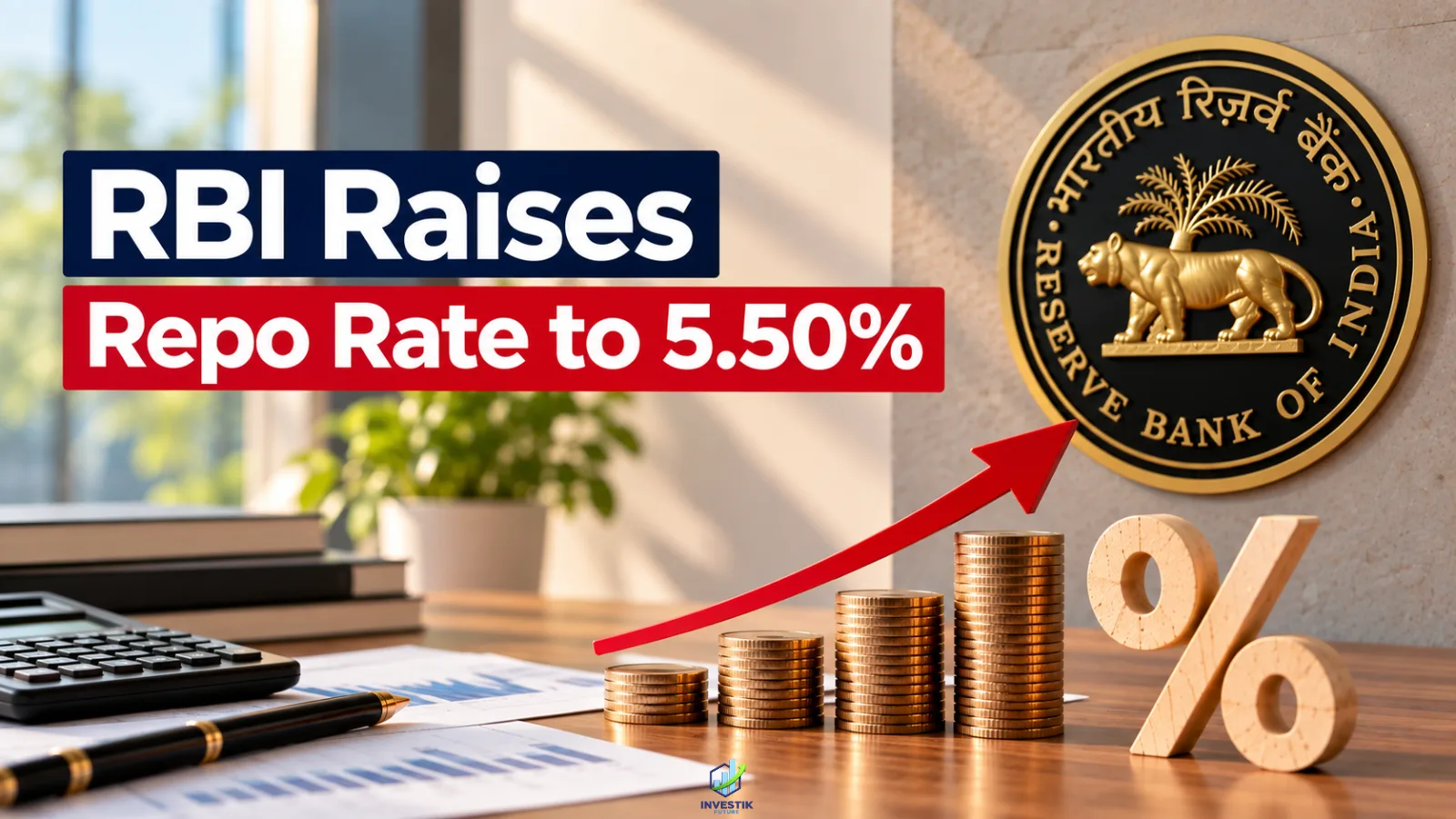

The Reserve Bank of India (RBI) raised the repo rate by 25 basis points to 5.50% on 7 October 2026. This is the first hike since February 2023. The Monetary Policy Committee (MPC) also changed its stance to “calibrated tightening”. Rising inflation, crude oil prices above $100 a barrel, and weak monsoon conditions were among the key factors behind the decision.
This article explains the RBI’s decision to raise the repo rate to 5.50%, the key factors behind the hike, and what the move could mean for borrowers, FD holders, and investors.
RBI Raises Repo Rate to 5.50%
Governor Sanjay Malhotra announced the decision after the MPC’s three-day meeting from 5 to 7 October. All six members voted for the hike.
| Particular | Details |
| New repo rate | 5.50% |
| Rate hike | 25 basis points |
| Previous repo rate | 5.25% |
| Date of decision | 7 October 2026 |
| Policy stance | Calibrated tightening (earlier: neutral) |
| SDF rate | 5.25% |
| MSF rate and bank rate | 5.75% |
The RBI cut rates by a total of 125 basis points in 2025. It then held the repo rate at 5.25% for four straight reviews. The last hike before today was in February 2023, when the rate went to 6.50%.
A basis point is one-hundredth of a percentage point. So a 25-basis-point hike means the repo rate went up by 0.25 percentage points.
Why Did RBI Raise the Repo Rate?
The main concern is that inflation is rising and price pressures are becoming broader. Here are the factors the RBI pointed to.
Retail inflation has been rising: August CPI inflation rose to 4.82% from 4.5% in July, staying above the RBI’s 4% target for the third month in a row. Core inflation, which leaves out food and fuel, rose to 4.2%.
Crude oil is above $100 a barrel: India imports most of the crude oil it uses. When oil gets expensive, the import bill goes up. Transport, manufacturing and power costs also rise, and businesses often pass these on to customers. The Governor flagged high oil price volatility as a risk to inflation.
The monsoon was weak: The Governor said deficient monsoon conditions and a strong El Niño could add to price pressures. They may also affect the upcoming Rabi crop. A poor harvest can push up food prices, and food has a large weight in India’s inflation basket.
Price pressures are spreading: The Governor said price pressures are becoming visible across a range of commodities. The RBI sees limited evidence of demand-side pressure, but it is watching strong growth in money and credit.
Growth gave the RBI room to act: The RBI raised its FY27 GDP growth forecast by 40 basis points to 7.1%, and the Governor described the economy as strong and broad-based. When growth is solid, a small rate hike is less likely to hurt the economy.
Inflation and the RBI’s Rate Decision
The RBI’s inflation target is 4%, with a tolerance band of 2% to 6%. So 4.82% is still within that range, but it is above the central target. The concern is the direction. If prices keep rising, people start expecting higher prices, and that makes inflation harder to bring down later.
The RBI’s main tool is the repo rate, which is the rate at which it lends short-term money to banks. A higher repo rate makes borrowing costlier across the system. People and companies then tend to borrow and spend less, and that can slow price rises.
The RBI also raised its FY27 CPI inflation forecast, which was 5.0% at its August review.
Rupee and Global Interest Rates
The rupee was trading around 96.45 against the US dollar in early trade on 7 October, before the announcement. A weaker rupee makes imports costlier, and that matters when crude is already expensive. The rupee is background here rather than a factor the RBI highlighted.
Some economists also say rising interest rates around the world have limited the RBI’s room to wait. That is an analyst view, not an RBI statement.
What Does RBI’s New Policy Stance Mean?
Until now, the stance was “neutral”, which meant the RBI could go either way. A majority of the MPC, four of the six members, voted to change it to “calibrated tightening”.
The change suggests the RBI is now putting inflation ahead of supporting growth through lower rates. The Governor said the next move can only be a hike or a pause, while future decisions will depend on incoming inflation and growth data.
The change does not commit the RBI to a fixed pace of future rate hikes. Its next decisions will depend on incoming economic data.
What Does the Repo Rate Hike Mean for Borrowers?
If you have a floating-rate loan, such as a home loan linked to the repo rate, your EMI or loan tenure may rise. But this does not happen automatically or by the same amount for everyone. It depends on your lender, your loan’s benchmark, and when your rate is next reset. Loans linked directly to the repo rate usually adjust faster than those linked to a bank’s own lending rate (MCLR), which change only on reset dates.
Here is an illustration. On a ₹50 lakh home loan for 20 years, an interest rate of 8.5% gives an EMI of about ₹43,391. If the rate rose to 8.75%, the EMI would be about ₹44,186, or roughly ₹795 more a month. This assumes the lender passes on the full 0.25 percentage points. Fixed-rate loans are not affected until they are renewed or refinanced.
What Does It Mean for FD Rates and Savers?
Your existing fixed deposit keeps earning the rate it was booked at until it matures. Banks may revise rates on new FDs and renewals, but there is no guarantee they will, and the size and timing differ from bank to bank. If you are opening or renewing an FD soon, it is worth comparing rates across banks.
What Does It Mean for Investors and the Stock Market?
A higher repo rate can increase borrowing costs and affect demand for loans. Rate-sensitive sectors such as real estate and autos may therefore come under pressure. Bond yields can also react as investors reassess the path of interest rates.
The actual market reaction will depend on how much of the hike was already priced in and what the RBI signals about future policy.
What Should You Watch Next?
- Monthly CPI inflation: this shows whether price pressure is easing or spreading.
- Crude oil prices: a sustained move above or below $100 could change the inflation outlook.
- Monsoon and Rabi sowing: these affect food prices.
- The rupee: it affects the cost of imports.
- Bank lending and deposit rates: these show how much of the hike reaches borrowers and savers.
- The next MPC meeting and its policy decision: the Governor has said the next move can only be a hike or a pause.
Key Takeaway
The RBI raised the repo rate by 25 basis points to 5.50% and changed its stance to calibrated tightening. The main reasons were rising inflation, expensive crude oil, a weak monsoon, and broader price pressure, with strong growth giving the RBI room to act.
If you have a floating-rate loan, keep an eye on your lender’s rate revision. If you are planning an FD, compare rates before booking. And watch inflation and oil prices, because they will shape the next decision.









FAQs
What is the RBI repo rate?
It is the rate at which the RBI lends short-term money to banks. It influences borrowing and deposit rates across the economy.
What is the new RBI repo rate in October 2026?
It is 5.50%, after a 25-basis-point hike announced on 7 October 2026. The earlier rate was 5.25%.
Why did RBI raise the repo rate?
Mainly because of rising inflation, crude oil above $100 a barrel, and weak monsoon conditions. The economy's strong growth also gave it room to act.
Will the repo rate hike increase home loan EMIs?
It can, for floating-rate loans, but not instantly or equally for everyone. It depends on your lender, your loan's benchmark, and when your rate is reset.
Will FD rates increase after the RBI repo rate hike?
Banks may raise rates on new FDs, but they are not required to. Existing FDs continue at their booked rate until maturity.
ARN Disclosure: Investik Future is an AMFI-registered Mutual Fund Distributor. ARN-341107 — Verify on AMFI ↗. Komal Thakur is the content author and digital marketer; the ARN registration belongs to Investik Future, not to the author personally.