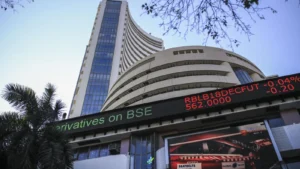

Bank Nifty was the first thing that caught my attention when I looked at the markets on Monday. The Bank Nifty index dipped sharply, pulling sentiment down across the broader market. Today’s fall seems to be driven by a mix of macro concerns, most notably rising crude oil prices and what that could mean for inflation and interest rates.
Let me break down what happened, what I observed, and how I’m personally interpreting this move. This article explains the steep decline in banking stocks as well as Bank Nifty, primarily on account of soaring crude oil prices and inflation-driven concerns that this may lead to a firmer monetary stance. It shows PSU and private bank declines, with PSU banks suffering more, and ties these moves to broader market trends, as well as recent advances in the banking space.
What Happened to Bank Nifty Today
The Bank Nifty index fell about 2.8 per cent intraday, down more than 1,556 points to a low of 54,356.20. That’s a sizable shift for a single session and clearly indicates the extent of selling pressure. What surprised me more was how the banking index underperformed the broader market, making it one of the worst-hit sectoral indices of the day.
When I looked deeper:
- The Nifty PSU Bank index fell by around 2.24%
- Nifty Private Bank index slipped about 1.37%
This tells me the selling wasn’t limited to just one segment; it was broad-based.
Why Are Banking Stocks Falling?
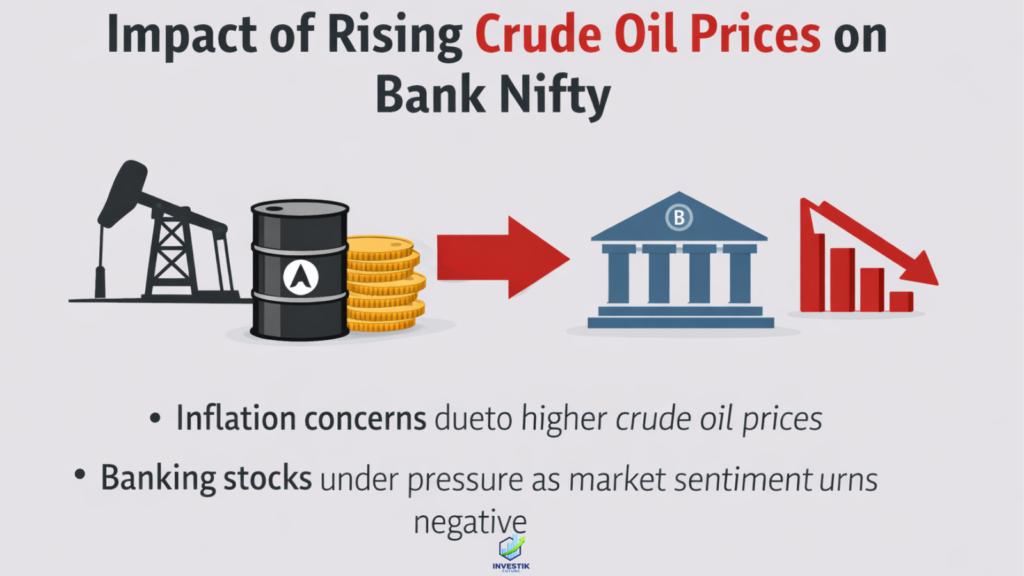
From what I understand, the main trigger is increasing crude oil prices. Higher crude prices can:
- Push inflation higher
- Raise pressure on the Reserve Bank of India (RBI) to tighten up its monetary policy
- Potentially delay rate cuts or even result in higher interest rates
As someone who is still trying to correlate macro factors with stock movements, this is something I am learning: Banking stocks are highly sensitive to interest rate expectations.
If rates remain elevated for longer:
- Borrowing costs increase
- Loan growth may slow
- Profitability outlook becomes uncertain
And markets often respond early to such expectations.

PSU Banks Took the Biggest Hit
One thing that was really noticeable today, PSU banks were hit harder than private ones. Some of the biggest losers included:
- Union Bank of India (down up to 4%)
- Bank of India
- Bank of Maharashtra
- Punjab National Bank
Seeing PSU banks fall more sharply made me think that these stocks had already seen strong rallies recently, so maybe some profit booking also played a role.
Private Banks Also Under Pressure
Even though the fall wasn’t as steep, private banks still saw noticeable declines. Key laggards included:
- HDFC Bank (down up to 2.47%)
- Axis Bank
- Kotak Mahindra Bank
- IndusInd Bank
Also, State Bank of India (SBI) turned out to be one of the biggest drags on the index, falling around 2.5%. For me, this signals that the weakness is not isolated; it’s spread across the entire banking space.
A Quick Look at the Bigger Trend
What makes this fall interesting is that it comes after a strong rally. According to market commentary, the banking index had already gained around 8.5% recently, supported by both PSU and private banks.
So, I’m wondering:
- Is this just a temporary correction?
- Or the beginning of a deeper pullback?
As someone still learning, I try not to jump to conclusions, but I do take note of such patterns.
Key Levels I’m Watching
I came across some technical insights that I found useful to understand the possible direction.
On the Upside:
- The index may retest 56,700 (near 200 DEMA)
- A further move could take it towards 57,800
On the Downside:
- Immediate support is seen around 54,300
- The next support level is near 53,000
I’m not someone who relies heavily on technical analysis yet, but I do think these levels help in understanding market sentiment zones.
Also Read: Sensex and Nifty Fall 1.5% Amid Global Market Uncertainty
How I’m Interpreting This Move
Personally, I don’t see this as a panic situation, but more like a reaction to macro uncertainty. Here’s how I’m thinking about it:
- The decline appears news-driven, not structural (at least for now)
- Bank stocks had already risen a lot, so some pullback is understandable
- So, rising crude prices are a genuine concern, but could also be temporary
At the same time, I’m trying to remind myself of one fact: As markets decline, they’re often moving ahead of real data.
What This Means for Investors Like Me
Since I’m still in the learning phase, I try to keep things simple:
- Avoid Overreacting: Steep declines may feel painful, but emotional responses tend to be bad decisions.
- Watch Macro Trends: Crude oil, inflation and RBI decisions appear to have a big influence on banking stocks, something I’m beginning to follow closely.
- Focus on Quality: Even during corrections, strong banks tend to recover faster (at least from what I’ve observed so far).
- Stay Patient: If this is just a correction, markets may stabilise when the macro concerns subside.
Final Thoughts
Today’s correction in banking stocks definitely took my attention, but it also gave me much-needed context on how global factors like crude can influence Indian markets directly.
Days like this are almost practical lessons in how markets respond to uncertainty. For now, I’m going to try to observe more and react less, gradually, whatever understanding emerges as opposed to trying to time each move.
Also Read: FPI Portfolio in India Sees ₹10L Cr Massive Drop in March
Frequently Asked Questions (FAQs)
1. Why is Bank Nifty falling today?
Bank Nifty declined significantly due to the rise in crude oil prices, which spurred fears of inflation and tightening monetary policy.
2. Which banking stocks were the biggest losers?
PSU banks that fell sharply included Union Bank of India, Bank of India and Punjab National Bank, while State Bank of India was the biggest loser among large banks.
3. Are rising crude oil prices bad for banking stocks?
Yes, crude prices when getting higher can raise inflation, which may lead to rising interest rates and upsetting growth in the banking sector.
4. Is this fall a correction or a trend reversal?
For now, it looks like a correction after a recent rally, but future moves will rely on macroeconomic data.
5. Should investors buy banking stocks during this dip?
It depends on individual strategy. But for some investors, it could be a buying opportunity, while others might want to wait until stability returns.
Disclaimer
This article is meant for informational and educational purposes only and represents personal observations. This article should not be seen as financial or investment advice. Past performance is not indicative of future results, and all investments are subject to risk.

Himani Soni
I’m Himani Soni, a finance content strategist with 2+ years at Investik Future. I decode market trends and simplify complex investing concepts into clear, actionable insights for the everyday investor.