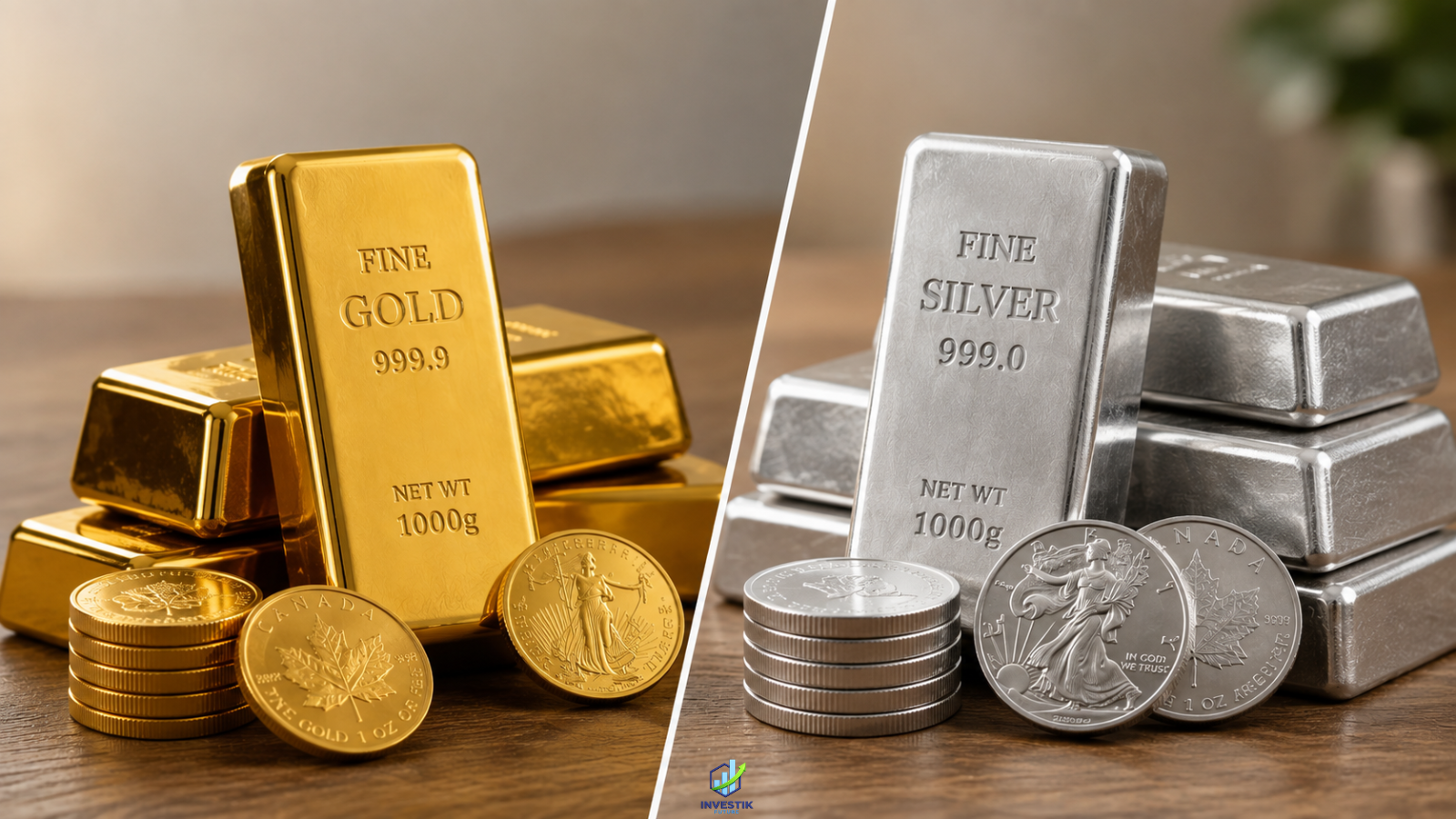

Gold and silver are often treated as two sides of the same investment. But they can behave very differently once you look beyond the fact that both are precious metals. Gold is generally considered the steadier choice, while silver can see much bigger price swings because it is also heavily used by industries.
So, if you’re looking to invest in precious metals for the long term, which one makes more sense for you: gold, silver, or perhaps a combination of both?
This article compares gold and silver as long-term investments, explaining how they differ, what drives their prices, their risks, and which option may suit different types of investors.
Gold vs Silver: What’s the Difference?
At a basic level, gold is mostly bought and held for one reason: to store value and add stability to a portfolio. Central banks hoard it, investors turn to it during uncertain times, and its price tends to move in fairly measured steps.
Silver, on the other hand, works a little differently. Yes, people invest in it the same way they invest in gold, but a large chunk of silver demand comes from industries, solar panels, electronics, batteries, and manufacturing. That dual identity, part investment metal and part industrial raw material, means silver often behaves more like a cyclical commodity than a pure store of value.
There’s also a liquidity gap. Gold has a much bigger, deeper global market, with more ways to buy and sell it easily. Silver’s market is smaller, which is part of why its price can move so much faster in either direction.
Neither of these traits makes one metal automatically “better.” They just make them different tools.
How Does Gold Behave as an Investment?
Gold’s appeal usually comes down to a handful of things. It’s widely used to diversify a portfolio, since it often doesn’t move in the same direction as stocks. It’s also seen as a place investors turn to during periods of uncertainty, geopolitical tension, market stress, or currency worries.
Central banks matter here too. Many countries, including India, hold and buy gold reserves, and that buying can influence prices over time. Gold can also be affected by interest rates and bond yields. When returns from interest-bearing investments change, investors may view gold differently.
That said, it’s worth being careful here: gold is often used as a way to diversify a portfolio and can attract demand during periods of uncertainty, but that’s not the same as calling it a guaranteed hedge against inflation. It doesn’t move in lockstep with inflation, and there have been long stretches where it hasn’t kept pace.
How Does Silver Behave as an Investment?
Silver’s story is really about two demands pulling in different directions. On one side, there’s investment demand, people buying coins, bars, or ETFs. On the other, there’s industrial demand, which has grown a lot in recent years thanks to solar panel manufacturing, electronics, and electric vehicles.
This creates a bit of a double-edged situation. When industrial activity is strong, silver can benefit from higher demand. But when growth slows, industrial demand can come under pressure.
This is a big part of why silver tends to be more volatile than gold; its price isn’t just about sentiment; it’s tied to how factories and manufacturers are actually using the metal.
Gold vs Silver: Which Is More Volatile?
It’s common to hear that “silver is riskier,” but that statement alone doesn’t explain much. Here’s the more useful version: silver generally experiences larger price swings than gold, in both directions.
A few reasons explain this. Silver’s market is smaller than gold’s, so it takes less buying or selling pressure to move the price meaningfully. It also carries that industrial demand layer, which reacts to economic cycles in a way gold mostly doesn’t. Add investment demand on top, and you get a metal where sentiment, factory orders, and economic data can all push the price around at the same time.
The important thing to understand is that higher volatility cuts both ways. It can mean sharper losses in a downturn, but it can also mean sharper gains when conditions favour silver. Whether that trade-off suits you depends entirely on your own comfort with seeing bigger swings in your portfolio.
What Drives Gold Prices?
Gold prices respond to a mix of factors rather than any single trigger:
- Interest rates and real yields: when returns on safer assets fall, gold tends to look more attractive.
- Inflation expectations: not a direct, guaranteed link, but investor expectations around inflation do influence demand.
- Geopolitical uncertainty: wars, conflicts, and political instability often push investors toward gold.
- Central-bank buying: large-scale purchases by central banks, including the RBI, can support prices.
- US dollar movements: gold is priced in dollars globally, so a weaker dollar often makes gold cheaper for other currencies, which can boost demand.
- General investor demand: flows into gold ETFs and physical gold add to price pressure during risk-off periods.
None of these work in isolation; it’s usually a combination that moves the price over time.
What Drives Silver Prices?
Silver prices are shaped by a similar but distinct mix:
- Industrial demand: solar panels, electronics, and EVs are major and growing consumers of silver.
- Investment demand: coins, bars, and ETF inflows add another layer of demand.
- Economic growth: stronger growth generally supports industrial silver use; slowdowns can hurt it.
- Gold price movements: silver often takes cues from gold, though the relationship isn’t fixed.
- Supply conditions: silver prices can also be influenced when mine production does not keep pace with demand.
The key message is simple: silver’s price is influenced by both investment sentiment and the health of the industrial economy, which is exactly why it doesn’t always move the way gold does.
Gold vs Silver for Long-Term Investment
| Factor | Gold | Silver |
| Volatility | Generally lower | Generally higher |
| Industrial demand | Limited | Significant |
| Portfolio role | More defensive | More cyclical exposure |
| Price swings | Usually smaller | Usually larger |
| Diversification | Commonly used | Can complement gold |
| Economic-cycle exposure | Lower | Higher |
This table isn’t a recommendation; it’s simply a way to see the two metals side by side. In plain terms: gold may make more sense for someone who primarily wants stability and diversification, while silver may suit someone who is comfortable with bigger price movements and wants exposure to industrial demand.
When Might Gold Make More Sense?
Gold may make more sense if you:
- Prefer lower volatility
- Want to diversify an equity-heavy portfolio
- Want a more defensive asset
- Don’t want as much exposure to industrial cycles
- Have a long-term investment horizon
That doesn’t make gold risk-free. Its price can still fall and may remain weak for extended periods.
When Might Silver Make More Sense?
Silver may appeal more to investors who:
- Can tolerate sharper ups and downs in value
- Want some exposure to industrial and technology-driven demand
- Are comfortable with a smaller, less liquid market
- Are looking to diversify their precious-metals holdings beyond just gold
As with gold, this isn’t personalised advice; it’s simply describing the kind of investor profile silver tends to suit better.
Should You Invest in Gold and Silver Together?
Here’s something that often gets missed in “gold vs silver” debates: you don’t necessarily have to pick just one. Since their price drivers aren’t identical- gold leaning more on macro and safe-haven demand, silver leaning more on industrial cycles- they can end up playing different roles in the same portfolio.
There’s no fixed formula like “70% gold, 30% silver” that works for everyone, and it would be misleading to suggest one. What’s more accurate to say is that some investors may choose to hold both because gold and silver respond differently to economic and market conditions, and that mix can give the portfolio exposure to two metals with different price drivers.
How Can Indian Investors Invest in Gold and Silver?
For gold, the common routes include:
- Physical gold: jewellery, coins, or bars, though this comes with making charges, storage concerns, and purity considerations.
- Gold ETFs: exchange-traded funds that track domestic gold prices and trade like stocks through a demat account.
- Gold mutual funds: fund-of-fund structures that invest in gold ETFs, useful for investors without a demat account.
- Sovereign Gold Bonds (SGBs): these have historically been another way for Indian investors to get gold exposure, but fresh issuance has been limited in recent years. It’s worth checking the latest government and RBI announcements before considering them.
For silver, the main options are:
- Physical silver: coins, bars, or utensils, which carry similar storage and purity concerns as physical gold.
- Silver ETFs: these have become widely available in India in recent years and are designed to provide exposure to silver without requiring investors to store physical metal themselves.
- Silver mutual funds: fund-of-fund options that invest in silver ETFs, again useful for investors who prefer not to use a demat account directly.
Product availability and rules can change, so it’s worth checking current details before investing rather than relying on older information.
What Are the Risks of Investing in Gold and Silver?
Precious metals aren’t risk-free, and it helps to be clear-eyed about that.
Price volatility. Both gold and silver can fall in value, sometimes sharply, and there’s no guarantee of when or whether prices recover.
No regular income. Unlike dividend-paying stocks or interest-bearing deposits, physical gold and silver don’t generate any regular cash flow while you hold them.
Gold-specific risks. Gold prices can be affected by interest-rate changes, currency movements, and shifts in investor sentiment, all of which are hard to predict.
Silver-specific risks. Silver’s industrial exposure makes it more sensitive to economic slowdowns, which can hit demand even if investment appetite stays strong.
Physical metal risks. Storage costs, purity verification, making charges, and the gap between buying and selling prices can all eat into returns on physical gold and silver.
Gold vs Silver: Which Is Better for You?
Rather than picking a winner, it helps to think in terms of what you’re looking for:
Gold may suit you better if you prioritise stability, want diversification against equity risk, and prefer not to deal with very large price swings.
Silver may suit you better if you can handle more volatility, want some exposure to industrial and technology demand, and are comfortable with bigger ups and downs along the way.
Both may make sense if you’d rather have exposure to two metals that respond to different forces, rather than betting everything on one.
The better choice isn’t simply the metal that has performed better recently. It is the one that fits the role you want it to play in your portfolio.




FAQs
Is gold better than silver for long-term investment?
Neither is universally "better." Gold tends to offer more stability and is commonly used for diversification, while silver offers higher potential swings tied to industrial demand. The right choice depends on your goals and risk tolerance.
Is silver riskier than gold?
Silver generally shows larger price swings than gold, driven by its smaller market size and its dependence on both investment and industrial demand. That higher volatility means investors should also be prepared for larger losses.
Can I invest in both gold and silver?
Yes. Many investors hold both, since the two metals often respond differently to the same economic conditions, which can help balance a portfolio.
Why is silver more volatile than gold?
Silver's price is influenced by industrial use as well as investment demand, and its market is smaller than gold's. Both factors make it more sensitive to swings in sentiment and economic activity.
Is gold a good investment for long-term investors?
Gold is commonly used for diversification and can provide some stability during uncertain periods, though it isn't risk-free and its price can still decline.
ARN Disclosure: Investik Future is an AMFI-registered Mutual Fund Distributor. ARN-341107 — Verify on AMFI ↗. Komal Thakur is the content author and digital marketer; the ARN registration belongs to Investik Future, not to the author personally.